
Recognize Choctaw County Deed Records
The Probate Judge serves as Choctaw County's land recorder. The county's own FAQ points land-deed filing to that office. That office also records mortgages and keeps the land records. The online instructions include a selectable field for instrument type. The labels below describe distinct conveyance functions. Match each one against the title on the actual indexed instrument before relying on it.
| Deed type | What it does | Common record question |
|---|---|---|
| Warranty deed | Conveys the stated interest with warranties written in the instrument | How an ordinary purchase was recorded |
| Quitclaim deed | Conveys whatever interest the grantor may hold without broad title warranties | Whether a possible interest was released or adjusted |
| Executor or administrator deed | Records a transfer made through estate authority | How estate land moved to a buyer or heir |
| Sheriff or foreclosure deed | Records a conveyance following the stated sale process | Whether litigation or sale produced a later transfer |
| Corrective or substitute deed | Repairs or reconstructs a prior record as the instrument states | Why a second filing refers back to an earlier deed |
A mortgage, lien, release, plat, or easement can sit beside deed records while serving another purpose entirely. Read the document title and its operative text. Never assume every indexed land item transfers ownership.
Open the Choctaw County Probate Land Service
The ING Probate portal for Choctaw County offers separate routes. One is for Land Records. The other is for Probate Case Records. The land route involves an account sign-in, new account creation, or Pay-Per-Document access. Its help information lists 205-459-2684 and choctawprobate15@yahoo.com for assistance. The service also posts its search instructions, terms, account guidance, and vendor help. Those terms warn that online information can contain errors. Activity on the portal is logged. Bots, scraping, automated account creation, and automated clicks are prohibited. Run a normal manual search. When accuracy counts, verify the index entry with the county office itself. The screenshot here comes from the official Choctaw Probate online-services page.
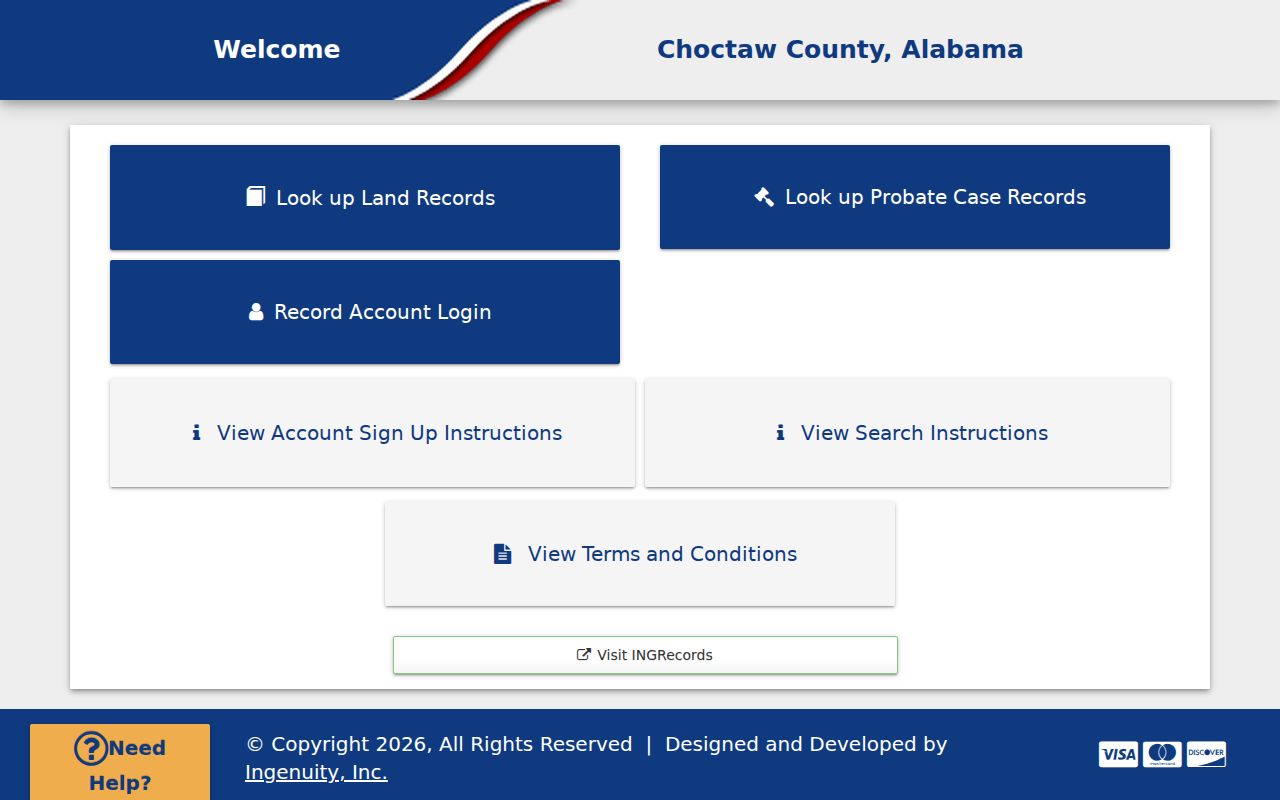
It shows the land-record entry point along with the account and document-purchase routes that frame access to scanned instruments.
Use Choctaw County Grantor and Grantee Fields
The portal instructions explain party-role and match controls in useful detail. Pick Grantor, Grantee, Assignee, or all. Then pair the name with a date range or another criterion. "Starts With" matches the beginning of a name. Leaving it unchecked runs a contains search. That distinction pays off with initials, middle names, company suffixes, and spelling variants.
| Portal choice | What to enter | Use in deed research |
|---|---|---|
| Grantor | Party giving or releasing an interest | Find deeds out from a known owner |
| Grantee | Party receiving an interest | Find an owner's acquisition instrument |
| Assignee | Party receiving an assigned interest | Follow an assignment when indexed that way |
| Date range | A broad span around the event | Reduce unrelated same-name entries |
| Book and page | Reference from GIS or another deed | Open a specifically cited record |
| Instrument type | One or more verified portal choices | Focus results without confusing Book Type |
The instructions also permit CTRL-click selection of multiple instrument types. No full live list exists to confirm every label. So treat no deed category as certain until the search form or Records Office confirms it. Run both party directions whenever the transaction is murky. One person can show up as grantee on an acquisition. That same person may appear as grantor on a later conveyance, and as assignee in a related filing. Widen the date window too, since a deed signed in one month may have been filed in another. When another instrument cites book and page directly, use it.
Walk the Choctaw County Deed Chain Backward
Start from the most recent credible deed reference, whether it sits on the GIS parcel card or in the Probate index. Chain work tracks parties and legal descriptions rather than street addresses alone. Rural situs fields may be missing, and addresses change over time.
- Locate the present owner's acquisition deed by searching that owner as grantee.
- Open the indexed record and capture the grantor, grantee, filing date, book/page, cross-references, and legal description.
- Search the same grantor as a grantee to find how that party acquired the interest.
- Repeat the sequence while comparing parcel descriptions and noting estate, corrective, foreclosure, or substitute instruments.
- Move to deed books, archive microfilm, probate files, and legal notices when the online path stops.
- Grantor
- The indexed party transferring or releasing the stated interest.
- Grantee
- The indexed party receiving the stated interest.
- Chain of title
- The linked sequence of conveyances and other instruments affecting the land.
- Book and page
- A recorded-document location, distinct from a parcel number and from any separate instrument identifier.
A tidy name sequence means little if the legal descriptions describe different land. Compare section, township, range, subdivision, lot, acreage, and adjoining-owner language exactly as the deed provides it.
Read Choctaw County Index Results and Cross-References
Search results can be filtered and paginated to a chosen count. They can also be sorted by criteria such as file date. Condensed and list views open in a new tab. The condensed view starts with the first indexed grantor or grantee. It includes a control that shows all indexed names, which matters for multi-party deeds. Book/Page opens a popup, and cross-reference details can point toward related filings. The instructions allow either a single-page document view or selected pages from a multipage image. A researcher can add the document to a cart and purchase it. A receipt and download link arrive by email. Logged-in users can revisit My Documents later. Ctrl+F speeds review of a long condensed list. Even so, check the index text against the chosen image. A truncated party list or cross-reference can shift the apparent chain.
Use GIS Deed Pointers Without Mistaking Them for Deeds
The Choctaw GIS detailed card can display DBook, DPage, and DDate. These appear next to the roll owner and parcel facts. They make strong launch points for deed records. They can lead straight to a recent instrument reference. They are not the deed itself. The card also lacks a reliable last-sale-price field. Copy each reference exactly. Then search the Probate system by book and page or by the named party around the deed date. If the parcel card owner and the newest indexed grantee disagree, compare dates and pull the image. The county publishes no fixed delay between recording and an assessment-roll update. For address-to-parcel mechanics in general, use the Choctaw County property search before entering the deed index. After the parcel is pinned down, keep this deed workflow anchored to the recorded instruments.
Reconstruct Choctaw County Deeds Lost to Fire
Fire is the first obstacle in old Choctaw County deed research. The Alabama Archives fire records document courthouse fires in 1859 and 1871. A Historical Commission nomination adds detail on an 1871 probate-office fire. A missing book entry means gaps in the chain. It is not proof that a transfer never happened.
Newspapers help fill the gap. A digitized 1875 Choctaw Herald issue carries petitions to substitute deeds destroyed by fire. It also prints sheriff and register sales, estate notices, and land-sale descriptions. Search by surname paired with geographic terms. OCR sometimes garbles a section, township, or range. Open the page image itself and read it directly. Then reconcile each notice against later deeds, plats, probate orders, and tax records.
Microfilm extends the reach further. Alabama Archives county film varies by record type and year. FamilySearch offers a statewide wills-and-deeds collection spanning roughly the 1700s through 2017. Choctaw image coverage is uneven, though. The local and Birmingham public-library guides add maps, marriage, will, divorce, cemetery, newspaper, and ancestral-homestead leads. These help in tracing old names.
Try the Ask the Archives database with Choctaw County plus a single term like "deed." The result is a finding aid. It is not a promised online image. Most originals stay with their county custodian. Note the reel, series, date span, and repository before requesting a copy.
Obtain a Choctaw County Deed Copy
The portal cart handles scanned images when one is available. Select only the pages you need. Complete the payment path and keep both the receipt and the document link. The office publishes no current per-page image charge, certified-copy fee, search fee, or complete recording schedule online, so verify costs before paying.
For a plain or certified office copy, write to Probate Judge Jason Sturdivant at 117 S. Mulberry Ave., Suite 9, Butler, AL 36904-2557, or call 205-459-2414 before sending any payment. Specify the exact book and page or indexed instrument. State the number of pages, whether certification is required, the delivery method, and the current cost. The office offers no dedicated mail-copy form.
What if the web index returns nothing for a cited reference? Give the office every known party spelling. Add the approximate execution and filing dates, the parcel or legal-description clue, and the source of the book/page citation. Ask whether the record sits in an older physical index, a deed book, a microfilm series, or a differently indexed cross-reference.
Recording fees and copy fees are separate things. Alabama law imposes a $2 local recording fee for each real or personal property instrument under §45-40-83.20, on top of other charges. State recordation tax runs $0.50 per $500 of value or fraction for deeds, and $0.15 per $100 of debt or fraction for mortgages. Neither filing tax is a copy price.
Recorded, not guaranteed. Choctaw County deed records show instruments accepted for filing. Recording alone is not a title opinion, does not validate every claim, and cannot reveal every unrecorded interest.
Certification matters only when an agency, court, lender, or legal process demands it. For preliminary history research, a plain image often suffices. Confirm that choice, and the current fee, with the Records Office before ordering.